16 Kitchen Light Fixture Ideas That Transform Any Space
 By zarcoyt2025
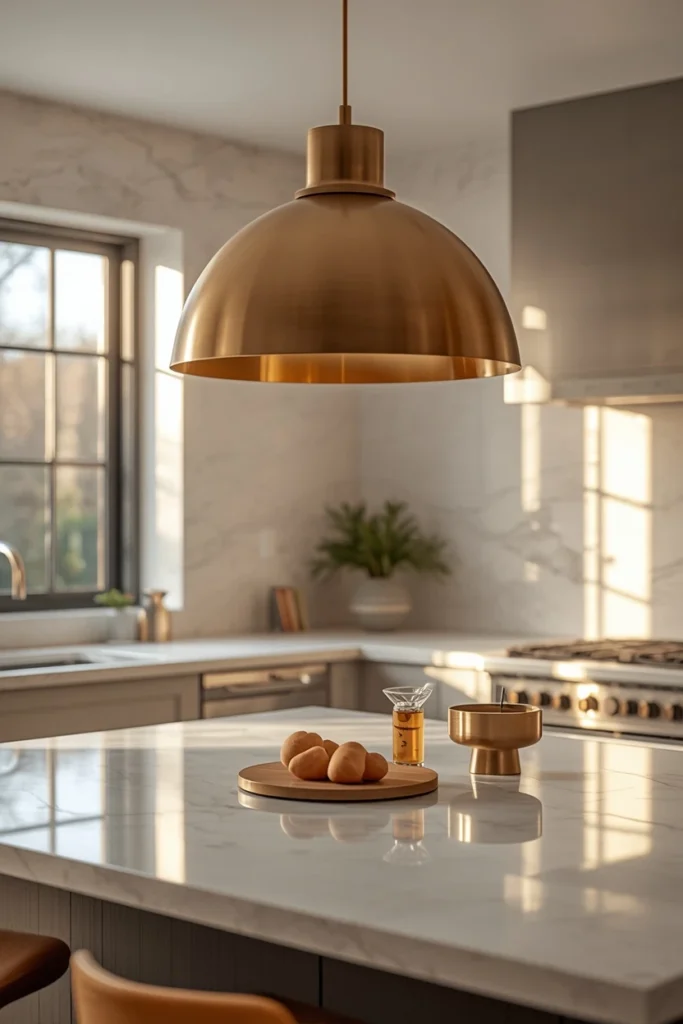
Table of Contents
- 1. Oversized Drum Pendant Anchoring the Island
- 2. Clustered Glass Globe Pendants in a Row
- 3. Black Iron Chandelier for a Farmhouse Kitchen
- 4. Linear Chandelier Over a Long Dining Counter
- 5. Brass Sputnik Kitchen Light Fixture for Low Ceilings
- 6. Woven Rattan Pendant for a Coastal Kitchen Mood
- 7. Industrial Cage Pendants with Vintage Bulbs
- 8. Crystal Semi-Flush Light Fixture for a Transitional Kitchen
- 9. Ceramic Dome Pendant in Matte White
- 10. Mixed-Metal Sconce Trio Along the Backsplash Wall
- 11. Sculptural Wood Bead Chandelier for Kitchen Warmth
- 12. Lantern-Style Pendant in a Traditional Kitchen
- 13. Recessed Cans Paired with One Statement Ceiling Piece
- 14. Copper Bell Pendants for a Mid-Century Tone
- 15. Art Deco Globe Chandelier in Smoked Glass
- 16. Minimalist Linear LED Fixture Over a Galley Kitchen
- Where I’d Start if I Only Did Three Things
- Frequently Asked Questions
- Final Thoughts
Walk into any well-designed kitchen and the first thing that pulls your eye upward is the light fixture. It anchors the entire mood before you even register the countertops or the cabinet color. Good kitchen light fixture ideas go beyond basic illumination — they define zones, signal a style direction, and turn a purely functional room into one that draws people in. Whether you are swapping out a builder-grade dome or starting fresh during a renovation, the fixture you select tells a story about the whole space.
What I have noticed after installing and testing different options over the years is that most homeowners overthink the shade material and underthink the scale. A beautiful pendant loses all its power if it hangs too low over the wrong surface. Every idea below pairs a fixture type with a real layout context so you are not just picking a pretty shape — you are choosing a lighting scheme that suits how your kitchen actually moves day to day.
1. Oversized Drum Pendant Anchoring the Island
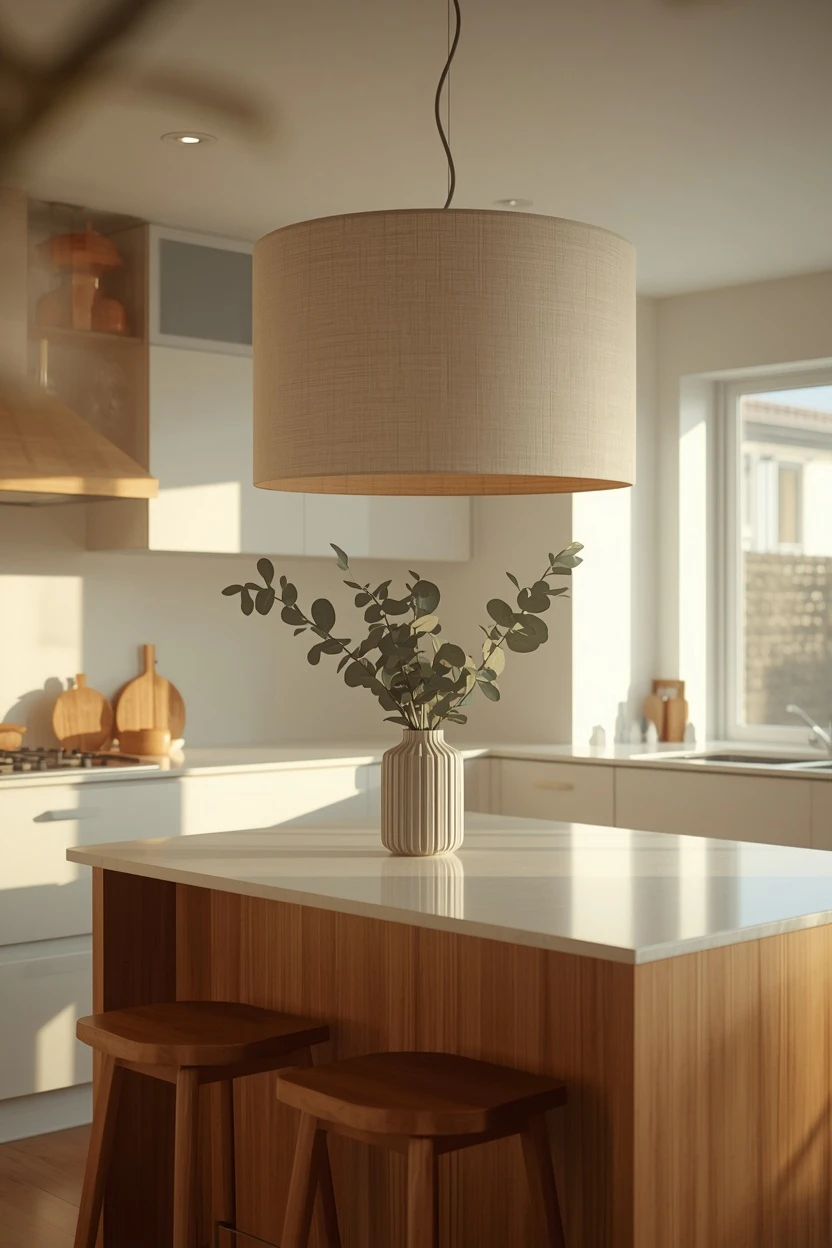
A single oversized drum pendant — somewhere around 24 to 30 inches in diameter — gives the island an instant center of gravity without cluttering the sightline. Linen or raw silk shades soften the glow and spread light evenly across the countertop, which matters when you are chopping at one end and plating at the other. Mount it roughly 30 to 36 inches above the counter surface so it lights the workspace without blocking eye contact across the room. The drum shape reads clean in both contemporary and transitional kitchens, and it pairs well with recessed cans around the perimeter for supplemental task light. One caveat: if your island is longer than six feet, a single drum can leave the ends dim — in that case, two smaller drums spaced evenly tend to perform better.
2. Clustered Glass Globe Pendants in a Row
Three or five clear glass globes hung at staggered heights over an island or breakfast bar create depth and visual rhythm without overwhelming the room. Clear glass keeps the kitchen open and bright because the light passes through in every direction rather than being trapped under a solid shade. Spacing them roughly 24 inches apart center to center keeps the grouping tight enough to read as a single design move.
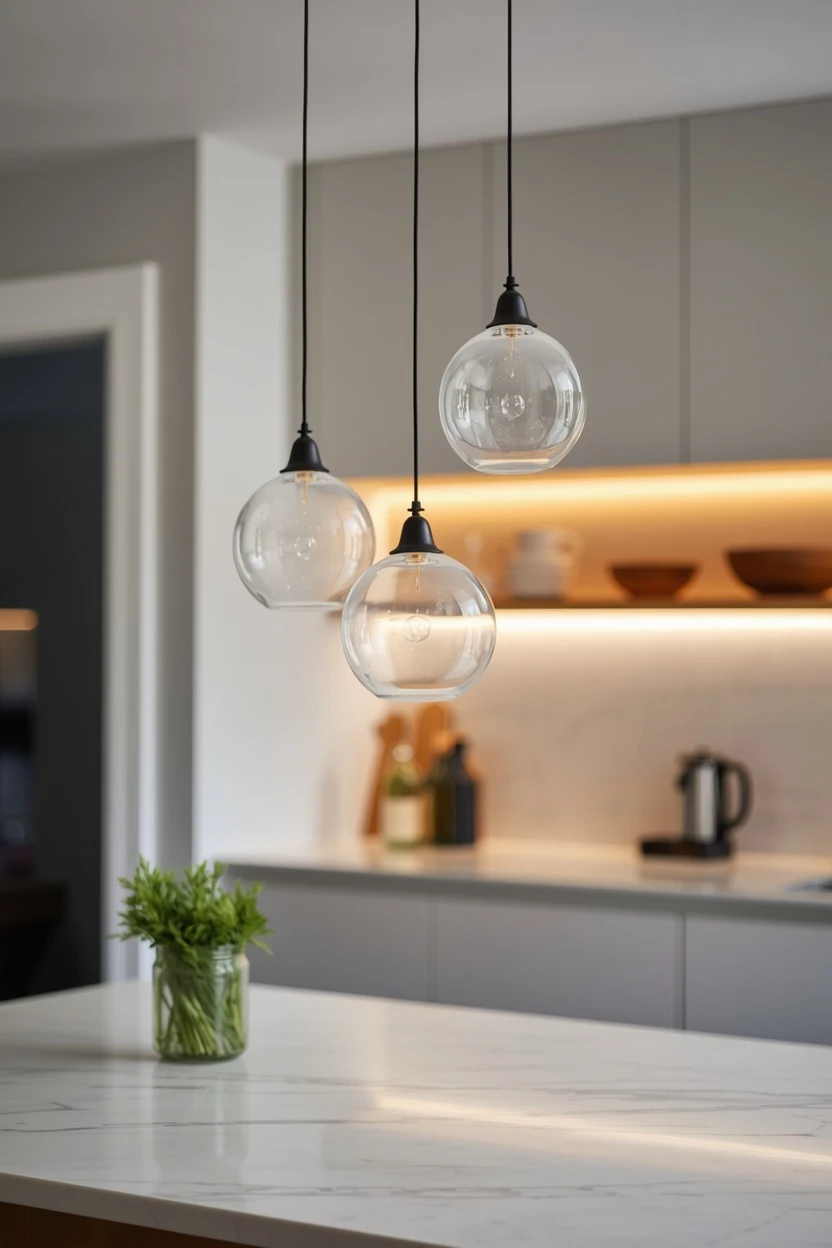
Opt for globes in the 8-to-12-inch range so they have presence without competing with the hood or cabinetry. A practical note — glass globes show every fingerprint and grease film, so plan to wipe them down monthly with a microfiber cloth dampened in white vinegar solution.
3. Black Iron Chandelier for a Farmhouse Kitchen
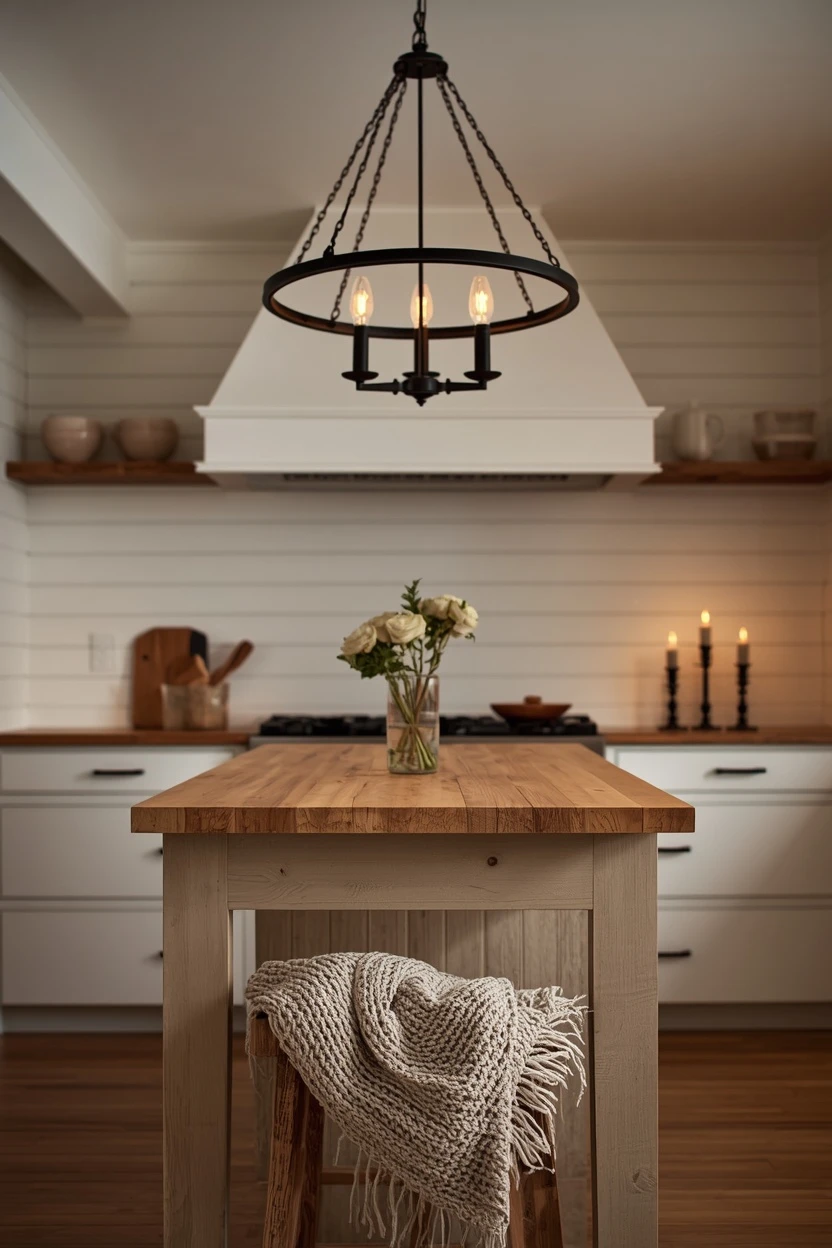
A wrought-iron chandelier with exposed candelabra bulbs adds serious character to a farmhouse or country-style kitchen without the heaviness of a traditional dining room piece. Look for open-frame designs — geometric cages or simple ring chandeliers — that let light pass through rather than pooling downward. Hanging it centered over the island or the eat-in table ties the seating area to the cooking zone visually. Black iron stands up well against white shiplap, butcher-block counters, and open shelving, creating contrast that grounds the room.
Watch the scale here: a fixture that measures at least 20 inches across keeps it from looking lost against a standard eight-foot ceiling.
4. Linear Chandelier Over a Long Dining Counter
When your kitchen includes a long counter or a harvest-style table that doubles as prep space, a linear chandelier stretches the light evenly across the full surface. These fixtures typically run 36 to 48 inches in length and sit close to the ceiling, which keeps them from dominating shorter rooms.
Bronze or satin brass frames paired with frosted glass shades give a polished tone without tipping into formality. I have found that centering the fixture lengthwise and keeping it roughly 32 inches above the surface strikes the best balance between atmosphere and usability.
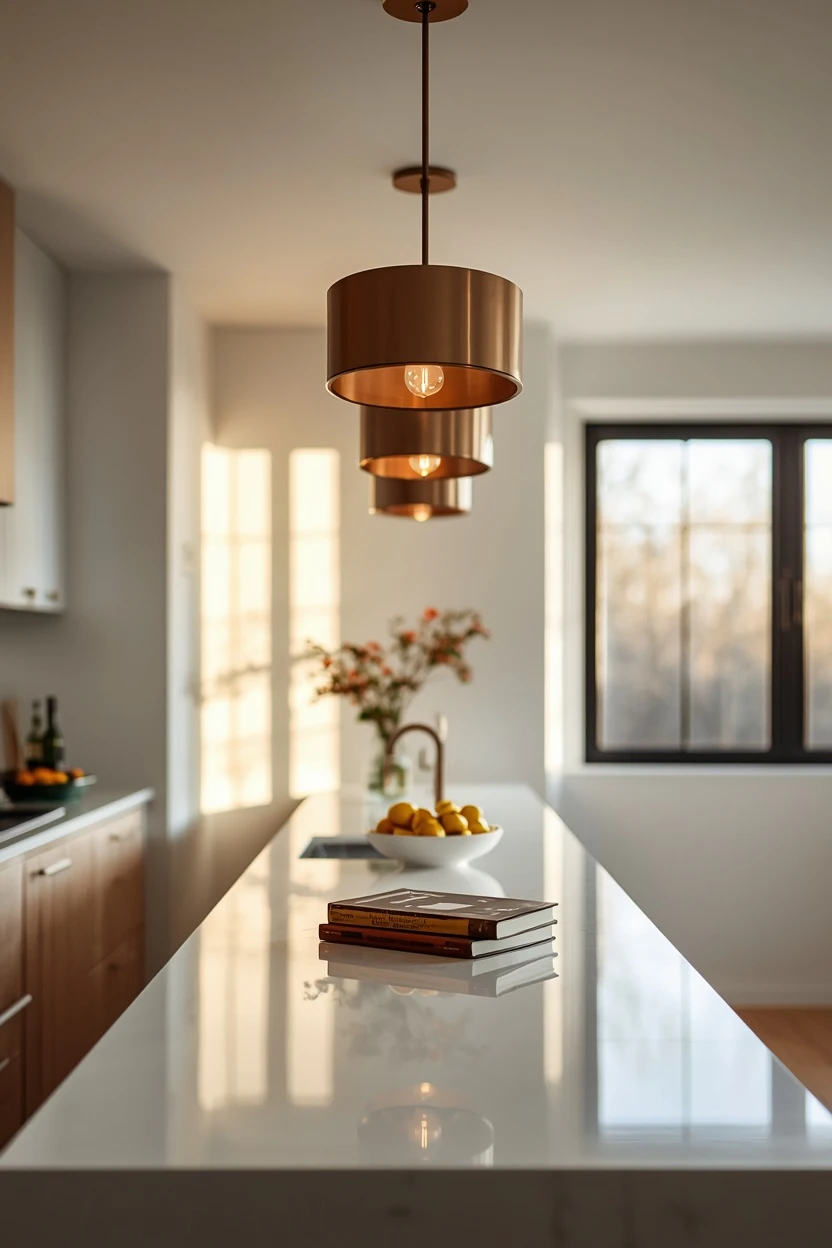
The linear shape also draws the eye along the counter, making a narrow kitchen read longer than it actually is.
5. Brass Sputnik Kitchen Light Fixture for Low Ceilings
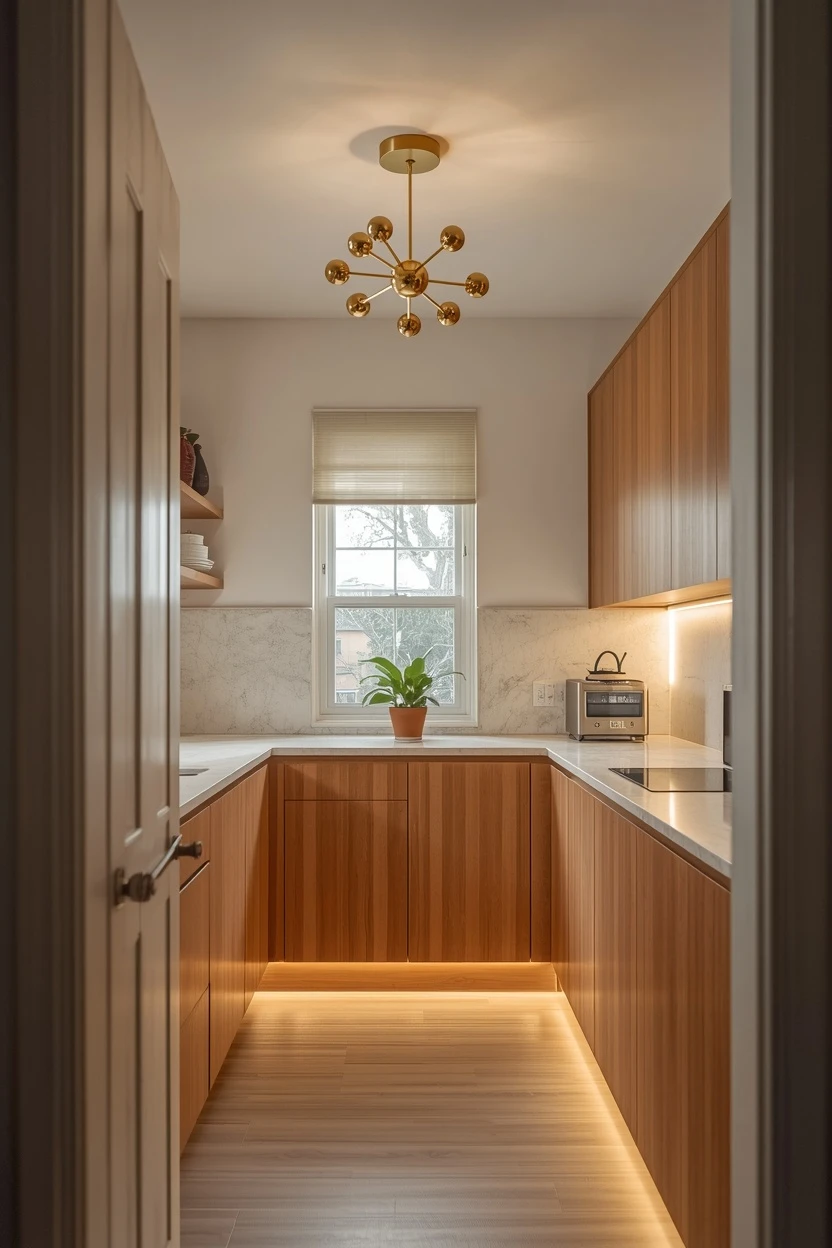
Kitchens with eight-foot ceilings or lower cannot support a hanging pendant without making the room cramped, but that does not mean settling for a flat builder dome. A brass sputnik flush mount — the starburst shape with multiple small bulbs radiating outward — delivers personality and even light distribution while sitting nearly flat against the ceiling. Satin brass or aged brass tones pair naturally with warm wood cabinets and marble surfaces. Position it over the primary work zone so it acts as the room’s main ambient source while under-cabinet strips handle the task lighting. One thing to watch: sputnik fixtures with more than twelve arms can look busy in a small kitchen, so eight to ten arms tends to be the sweet spot for spaces under 150 square feet.
6. Woven Rattan Pendant for a Coastal Kitchen Mood
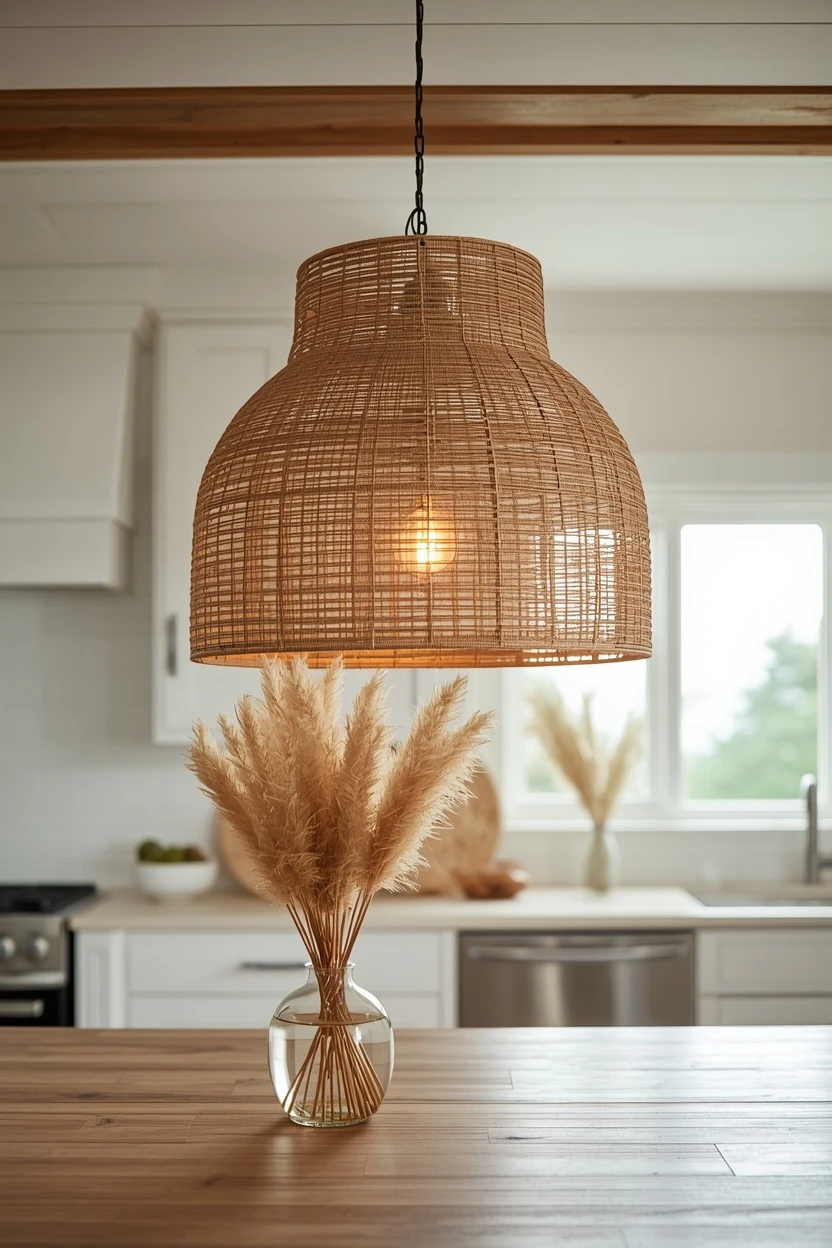
Natural rattan or wicker pendants bring texture and warmth into a kitchen in a way that metal and glass simply cannot replicate. The woven fibers cast intricate shadow patterns across the ceiling when lit, which adds a layered atmospheric quality to the space after sundown. Rattan reads especially well against a coastal or Mediterranean palette — think soft whites, sandy beiges, and pale blue-green accents. Size up: go at least 18 inches in diameter for a pendant that registers from across an open-plan room.
The trade-off is durability — rattan absorbs humidity and cooking moisture over time, so avoid hanging it directly above the range or steam-heavy zones. Over the island or a dining nook is the safer placement.
7. Industrial Cage Pendants with Vintage Bulbs
Wire cage pendants with exposed filament bulbs suit loft-style kitchens, warehouse conversions, and any space leaning into raw materials like concrete, brick, or blackened steel. The open cage structure means you sacrifice some shade-directed light, so pair them with strong recessed or track lighting elsewhere in the kitchen for adequate task coverage.
Grouping two or three cages over the island at slightly different drop heights gives the arrangement a collected-over-time quality that avoids the showroom look. Matte black cages maintain a graphic edge, while aged bronze softens the industrial tone.
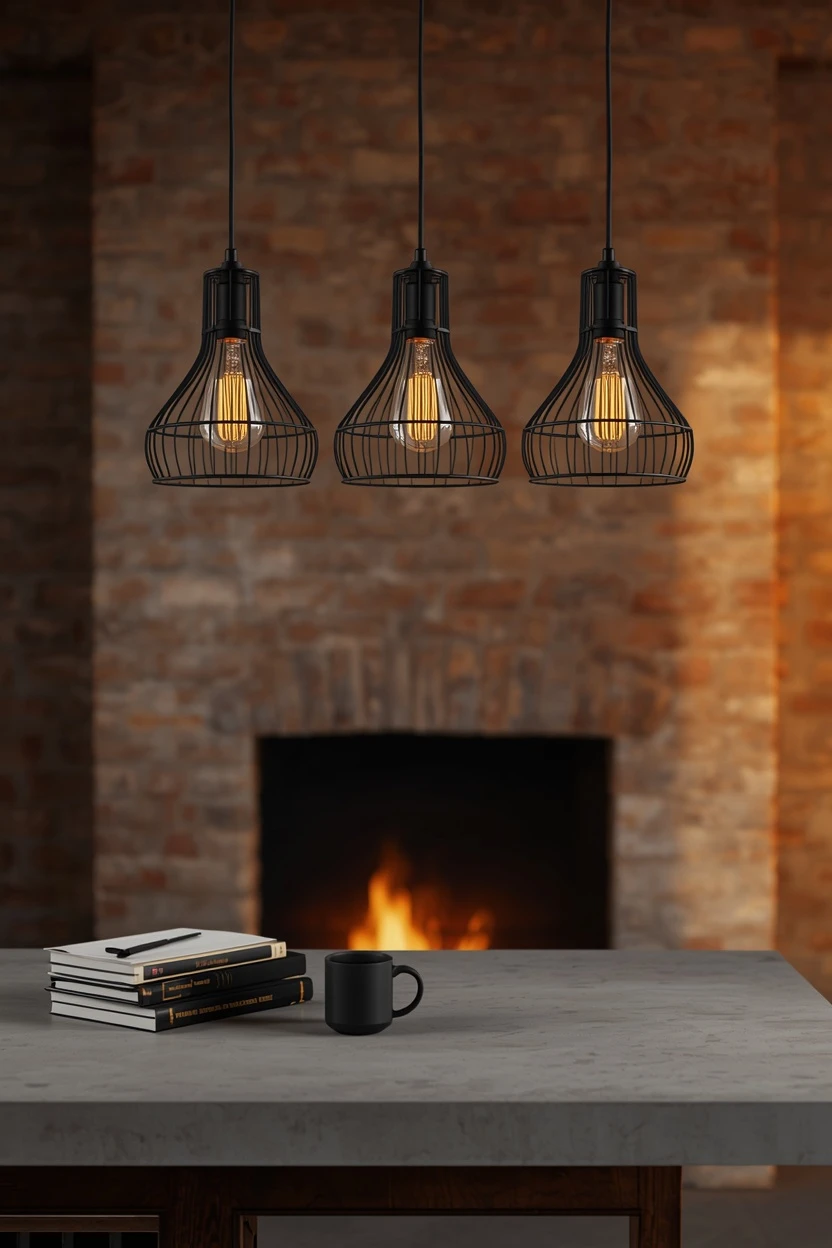
Keep in mind that vintage-style filament bulbs produce noticeably less lumens than standard LEDs, so choose hybrid LED filament bulbs rated at 2200K to 2700K for both the amber glow and usable brightness.
8. Crystal Semi-Flush Light Fixture for a Transitional Kitchen
A crystal or cut-glass semi-flush mount adds a refined sparkle to kitchens that sit between traditional and modern. Unlike a full chandelier, the semi-flush silhouette hugs the ceiling closely — usually dropping just four to eight inches — which makes it viable even in compact kitchens. The crystal refracts overhead light into small prismatic patterns across the walls, introducing a decorative element you cannot achieve with fabric or metal alone.
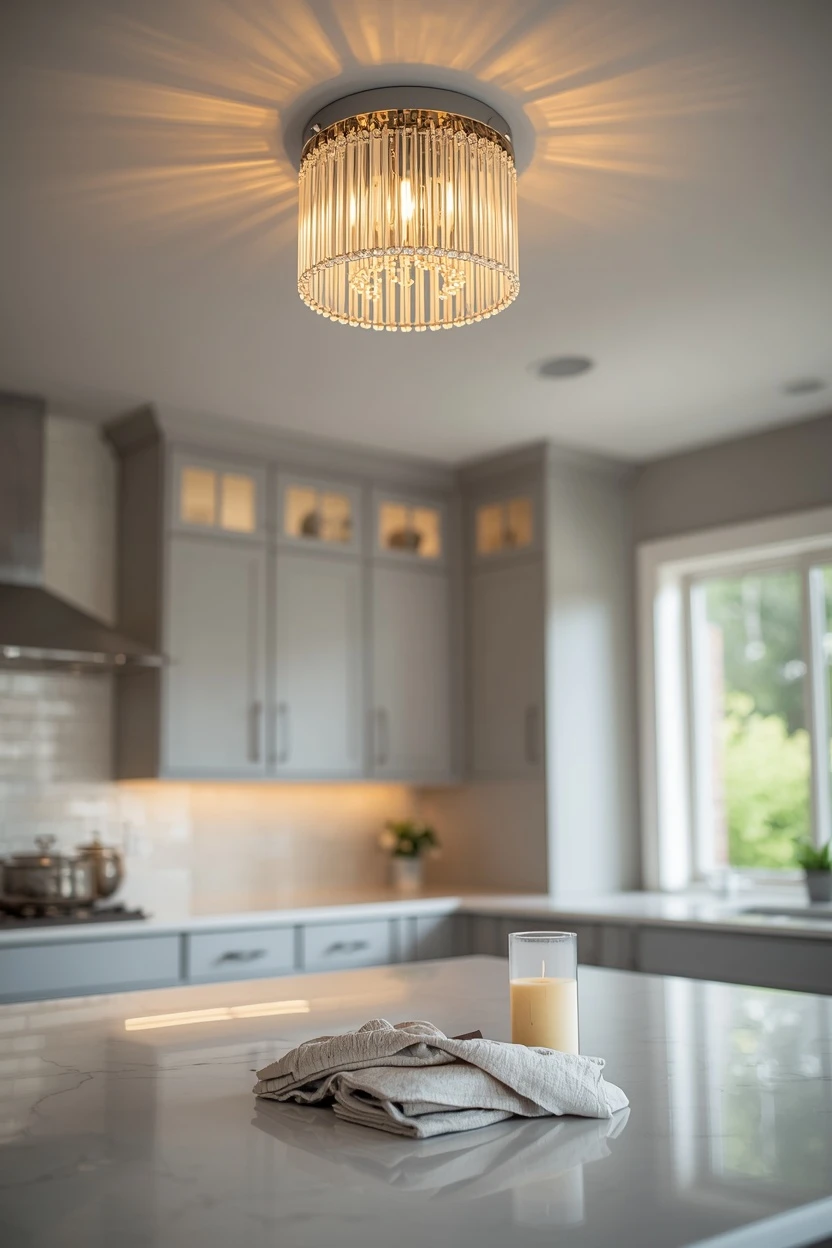
Pair it with brushed nickel hardware and light-toned counters for a pulled-together transitional scheme. One honest caveat: crystals collect grease and cooking residue faster than simpler fixtures, so you may need to take the fixture down for a thorough cleaning every six months if it is near the cooktop.
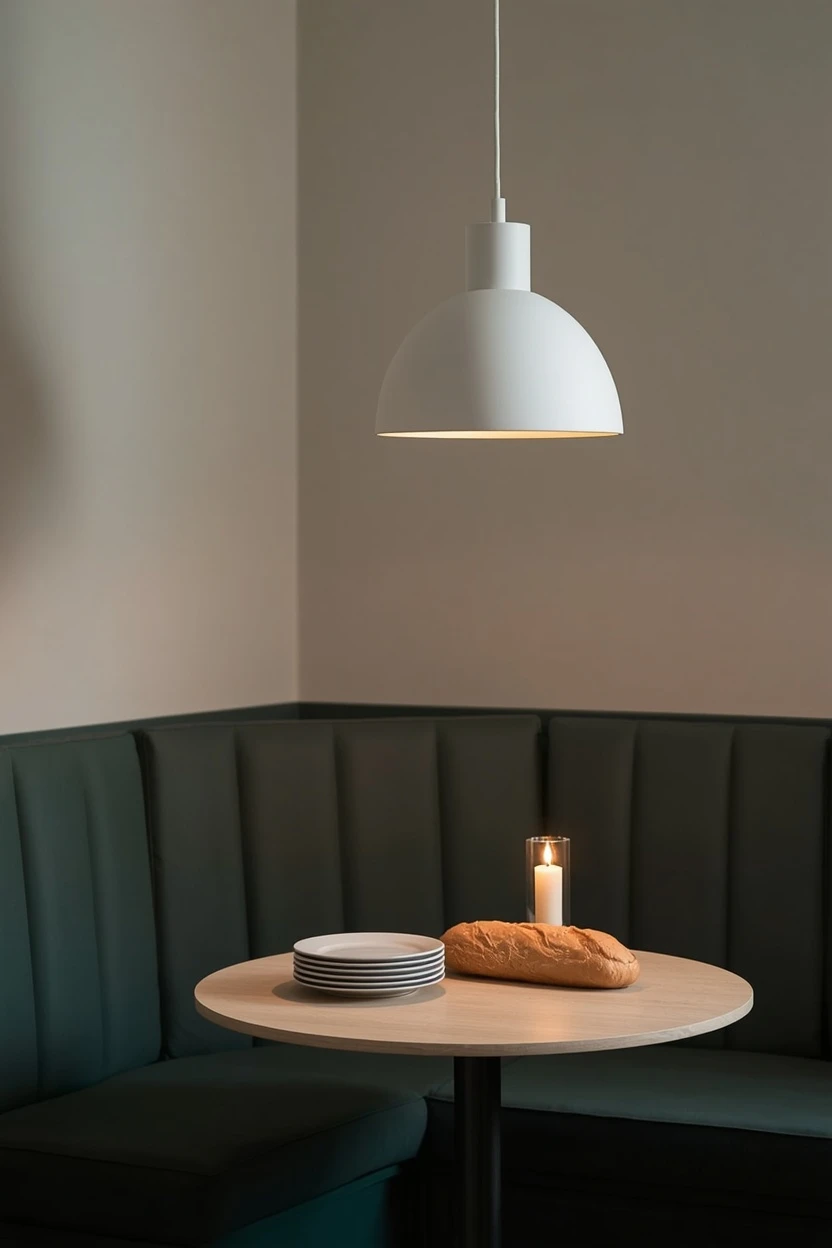
9. Ceramic Dome Pendant in Matte White
There is something quietly confident about a matte white ceramic pendant — it adds substance and shape without pulling attention away from the rest of the room. The dome directs light downward in a focused pool, which makes it ideal over a prep station or a small breakfast nook where you need concentrated task illumination. Ceramic shades weigh more than aluminum or fabric, so confirm that your junction box and mounting hardware are rated for the load, typically around eight to twelve pounds for a 16-inch dome. The matte surface hides dust better than gloss and resists fingerprints, which is a practical advantage over polished metal in a kitchen with constant traffic. These look especially striking against dark green or navy cabinetry where the white dome pops as a clean focal point.
10. Mixed-Metal Sconce Trio Along the Backsplash Wall
Wall sconces rank among the most overlooked kitchen light fixture ideas, yet they can transform a flat backsplash wall into a genuine design feature. Installing a row of three sconces — spaced 30 to 36 inches apart — above open shelving or between upper cabinets creates a layered look that overhead lighting alone cannot achieve. Mixing metals deliberately, such as one brass sconce flanked by two in matte black, adds a collected quality that suggests the room evolved over time.
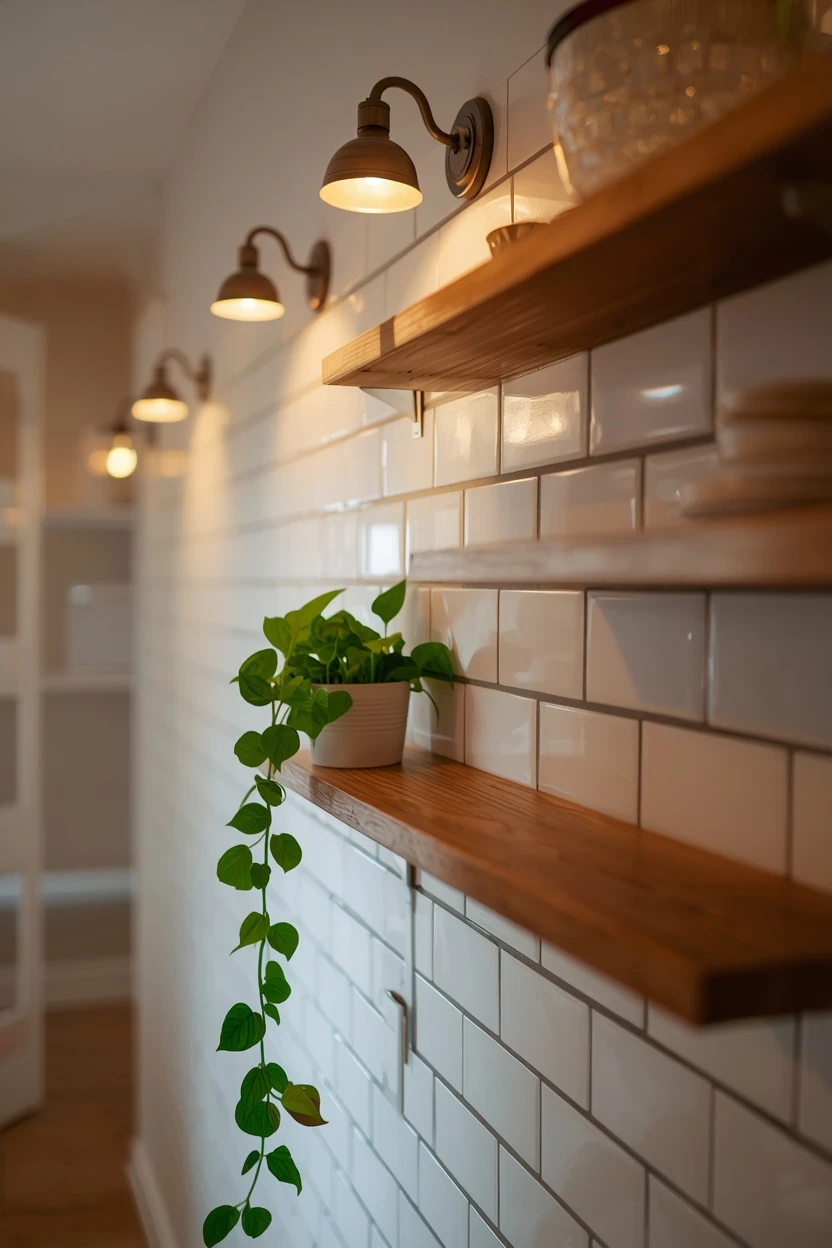
Choose sconces with upward or dual-directional shades so they wash light along the wall and ceiling rather than creating harsh downward spots. This approach is especially effective in galley kitchens where the long wall is the primary visual surface you see upon entry.
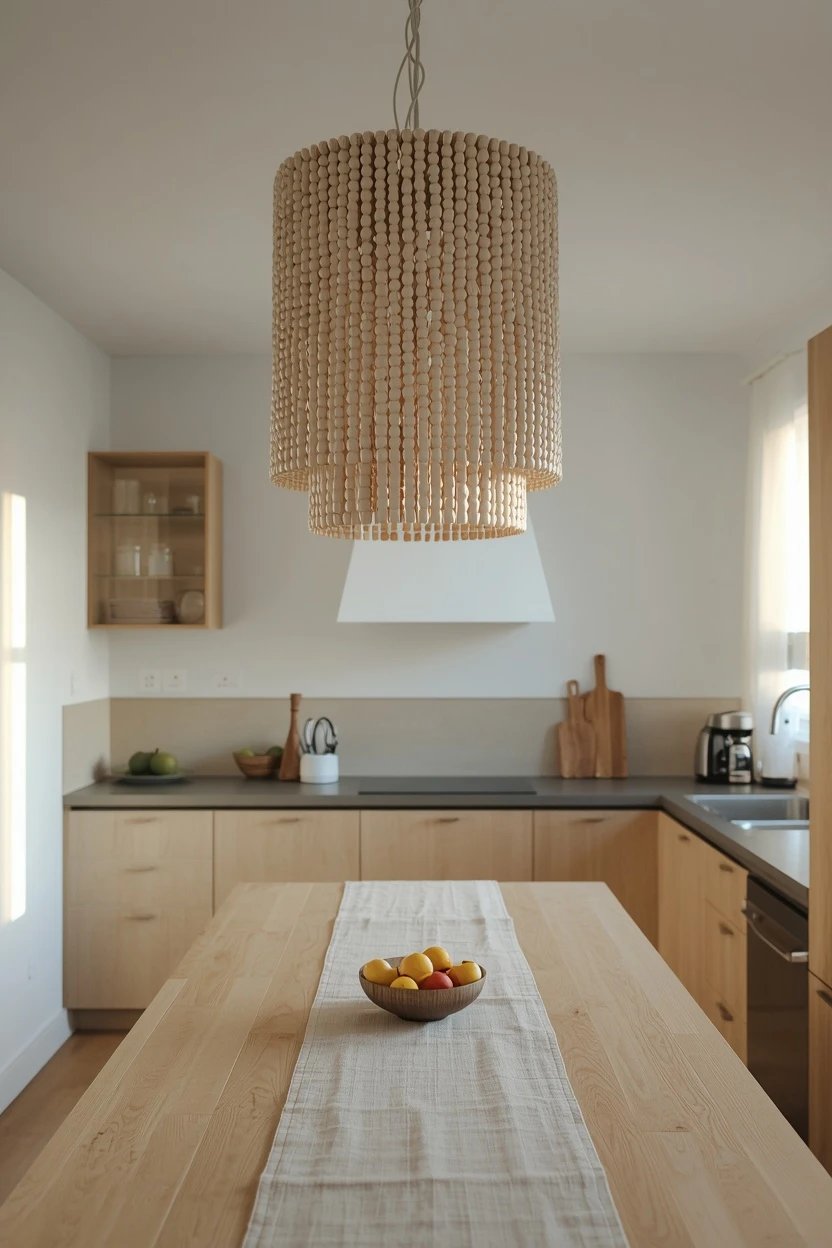
11. Sculptural Wood Bead Chandelier for Kitchen Warmth
A wood-bead chandelier softens a kitchen in a way that no metal fixture can match, bringing an organic and handcrafted quality to the room. The layered strands of beads create gentle curves and shadows that shift as you move around the space, making the fixture look slightly different from every angle. Whitewashed beads suit lighter kitchens with Scandinavian or coastal leanings, while raw or honey-stained beads pair with rustic and mid-century palettes. Size matters more than usual with bead chandeliers — anything under 20 inches across tends to look like a bedroom fixture, so aim for the 24-to-30-inch range for a kitchen.
Dust is the main maintenance concern: a soft-bristle brush attachment on a vacuum handles the beads gently without knocking them loose.
12. Lantern-Style Pendant in a Traditional Kitchen
A lantern pendant — the kind with four glass panels in a metal frame — brings a sense of architecture to a traditional or colonial-style kitchen. The enclosed glass panels protect the bulb from kitchen grease while still allowing light to radiate in every direction, which is a genuine functional advantage over open-frame fixtures.
Oil-rubbed bronze and antique brass are the classic frame finishes, and both age gracefully in a kitchen environment. Hang the lantern centered over the island or over a round eat-in table for the most balanced visual weight.
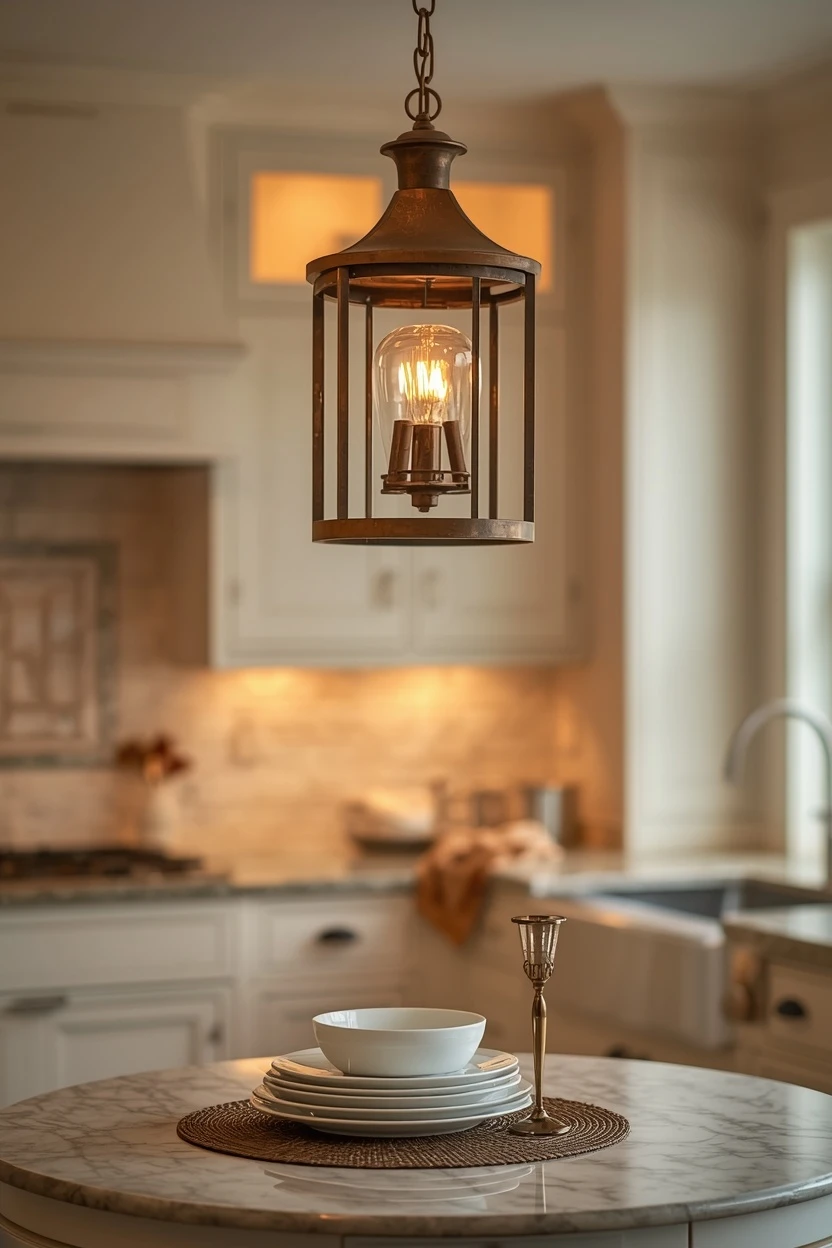
These fixtures tend to run deeper than they are wide, so measure the vertical clearance carefully — a lantern that drops 22 inches below the ceiling eats more headroom than most homeowners expect.
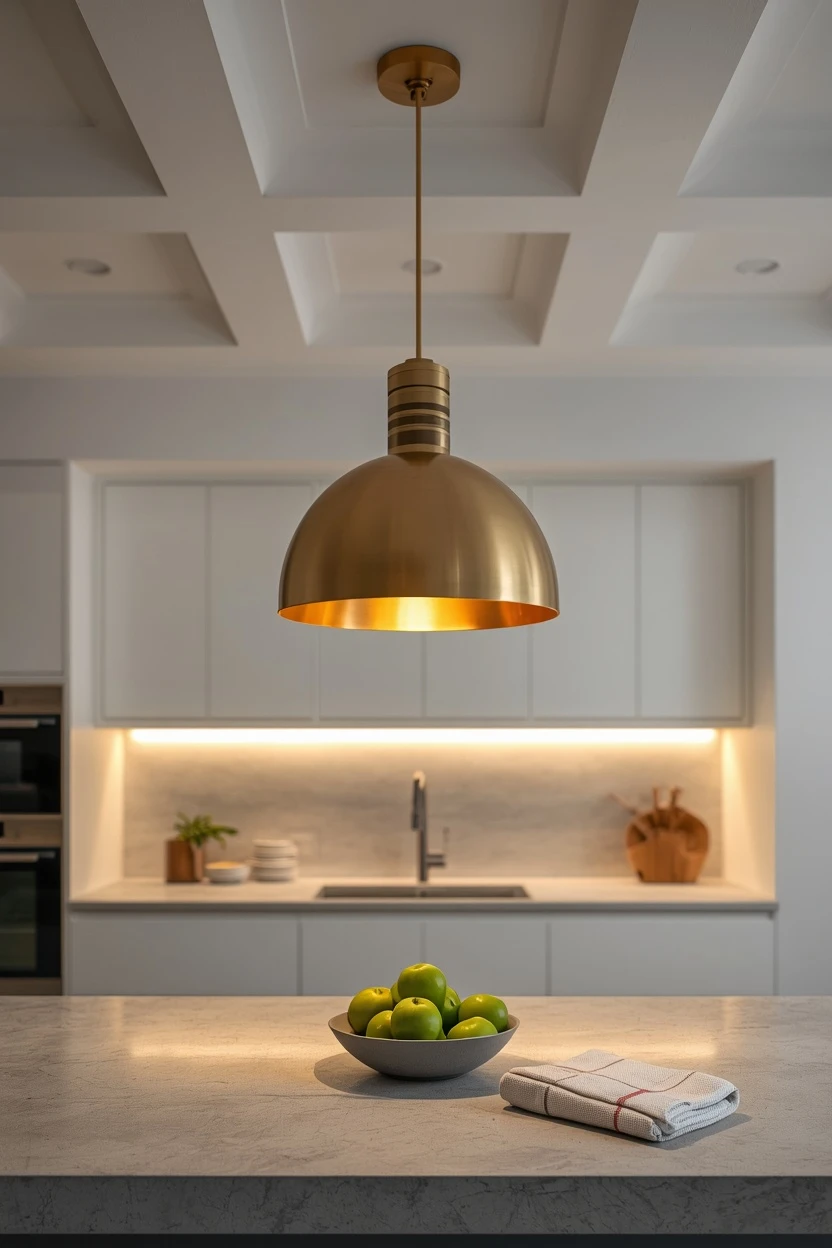
13. Recessed Cans Paired with One Statement Ceiling Piece
Sometimes the strongest lighting approach is a hybrid one — a grid of recessed cans for even ambient coverage combined with a single bold decorative fixture for personality. The recessed cans do the heavy lifting at 3000K to 4000K, providing consistent light across the counters and floor, while the statement piece over the island or sink adds a design focal point that the recessed cans lack. This setup also gives you separate dimmer circuits, which means you can kill the overhead cans for a moody evening and leave just the pendant glowing softly. It is a more practical strategy than depending on a single decorative fixture for all your kitchen light fixture needs. Budget roughly two recessed cans per 25 square feet of floor space for adequate general illumination.
14. Copper Bell Pendants for a Mid-Century Tone
Hammered or smooth copper bell pendants bring a rich, warm metallic tone that deepens over time as the copper develops a natural patina. The bell shape funnels light downward in a tight cone, making these pendants particularly effective above a dedicated prep area or a narrow bar counter where focused light matters more than broad ambient coverage. Pair copper with walnut cabinetry, terrazzo surfaces, and muted olive or mustard accents for a cohesive mid-century look.
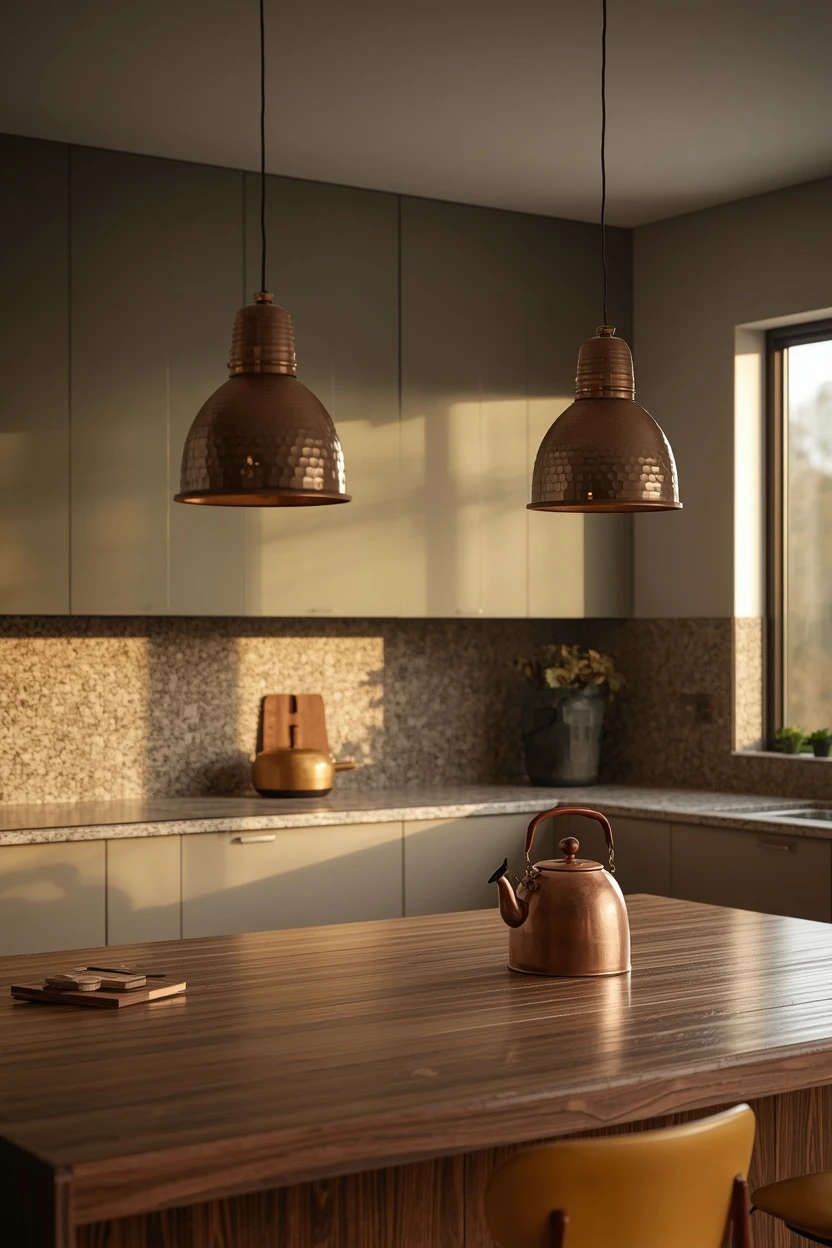
Two copper bells spaced evenly over a six-foot island deliver balanced coverage without crowding. One practical note: if you prefer the bright penny-copper tone and want to prevent patina, you will need to apply a lacquer or clear wax coating every few months — otherwise the surface will darken to a brownish-bronze within a year or two.
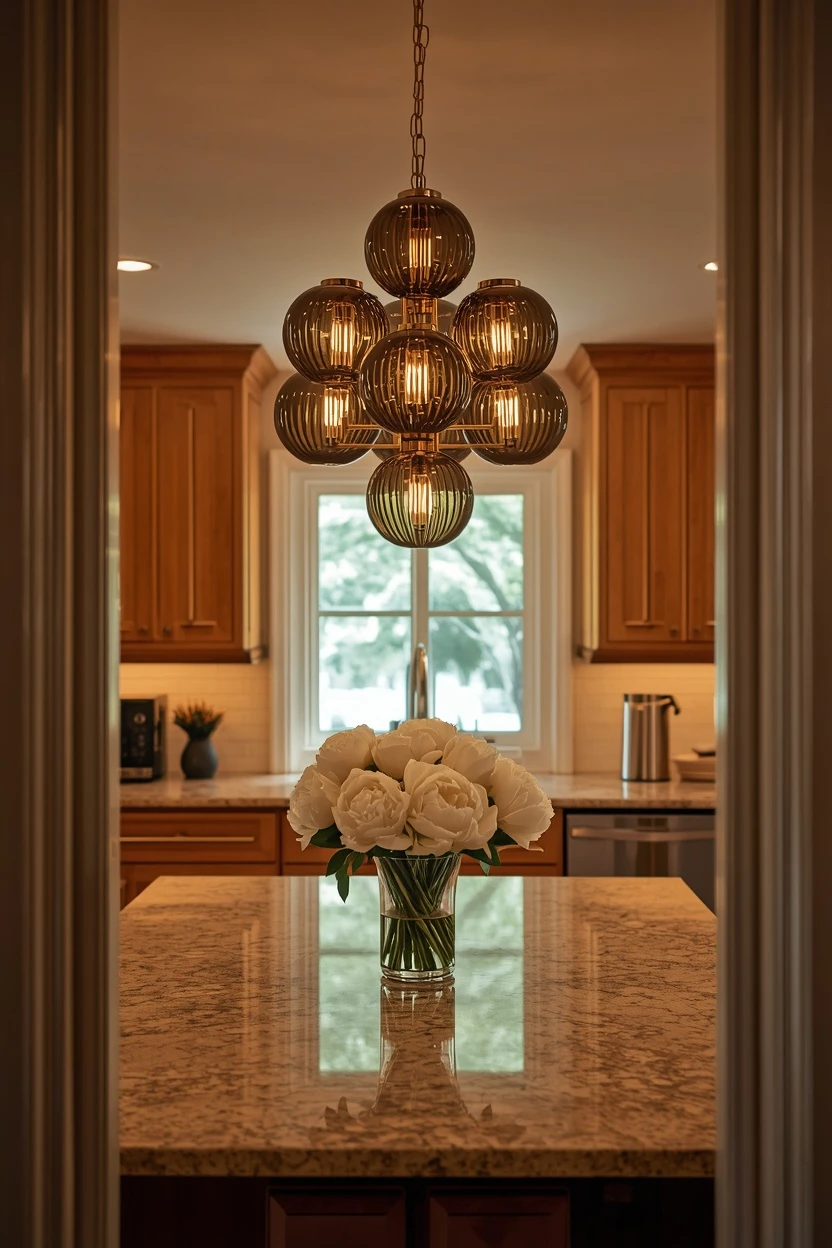
15. Art Deco Globe Chandelier in Smoked Glass
A smoked-glass globe chandelier with brass or gold-tone hardware channels Art Deco glamour into a kitchen without looking overwrought. The tinted glass filters the bulb to a soft amber glow that flatters warm-toned surfaces like honey marble, oak floors, and brass cabinet pulls. Look for multi-globe designs where three to five spheres cluster at different heights — the staggered arrangement catches light at multiple planes and adds dimension to the ceiling space. These fixtures pair naturally with fluted or reeded glass cabinet fronts, arched doorways, and geometric tile backsplashes that echo the Deco vocabulary.
Keep surrounding finishes simple so the chandelier remains the clear star rather than competing with other busy patterns in the room.
16. Minimalist Linear LED Fixture Over a Galley Kitchen
For a galley kitchen where every inch of ceiling space is visible, a slim linear LED fixture running the length of the room provides clean, even light without any visual bulk. These fixtures mount flush or nearly flush and come in profiles as thin as one inch deep, which preserves every bit of headroom.
Look for fixtures with a warm 2700K to 3000K color temperature and a CRI above 90 so food and surfaces render in true, appetizing color rather than the flat blue-white cast of lower-quality LEDs. Matte black or brushed aluminum housings read modern and disappear against a white ceiling.
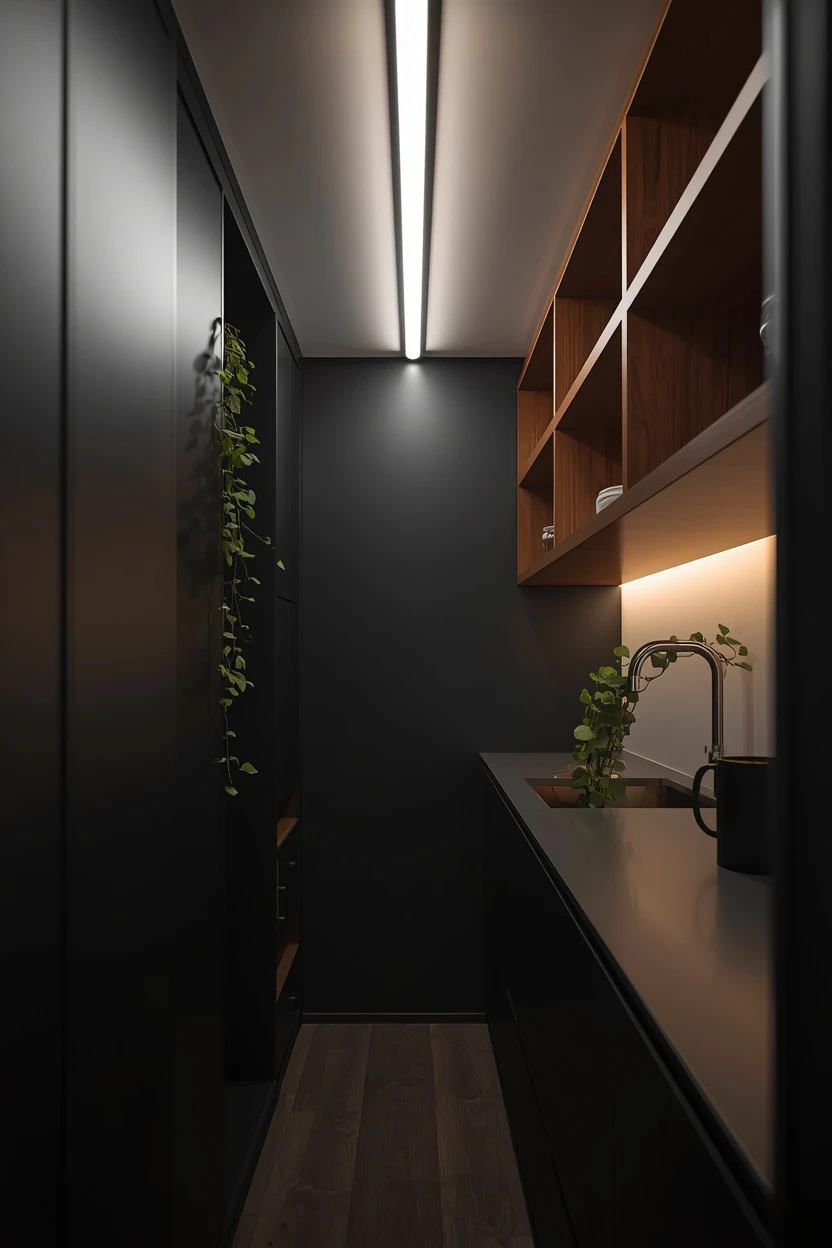
This is the most utilitarian kitchen light fixture approach on this list, but in a narrow galley where pendants would block traffic flow, it is the smartest solution by far.
Where I’d Start if I Only Did Three Things
If I only did three things, I would start by measuring my ceiling height and island length — those two numbers eliminate half the fixture styles immediately and save you from expensive return shipping. Next, I would install a simple dimmer switch on whatever fixture I chose, because a dimmable pendant at 40 percent brightness after dinner transforms a kitchen more than any shade material or metal tone ever will. Third, I would add two or three under-cabinet LED strips on the main work counter to handle task light separately, so the overhead fixture is free to be purely atmospheric when the serious cooking is done.
Frequently Asked Questions
What are the best kitchen light fixture ideas for low ceilings?
Flush mounts and semi-flush mounts keep the light source within a few inches of the ceiling, so they work in kitchens with standard eight-foot ceilings where a pendant would hang too low. Sputnik flush mounts and slim crystal semi-flush designs add visual interest without sacrificing headroom. Recessed cans combined with under-cabinet strips are another strong option when you want a clean ceiling plane with no protruding fixtures at all.
How high should pendant lights hang above a kitchen island?
A general rule is 30 to 36 inches between the bottom of the pendant shade and the countertop surface. This height keeps the light focused on the work area while leaving a clear sightline for conversation across the island. Taller household members or islands used primarily for dining rather than prep may benefit from raising the fixture an inch or two higher to avoid head bumps.
Can I mix different fixture types in one kitchen?
Absolutely, and layered lighting is usually the better approach. A decorative pendant or chandelier over the island handles the focal point role, recessed cans provide even ambient coverage across the full kitchen, and sconces or under-cabinet strips layer in task and accent light. The key is keeping the metal tones within the same family — mixing brass with matte black reads deliberate, while mixing chrome with oil-rubbed bronze can look accidental.
How many pendants do I need over a kitchen island?
For islands up to five feet long, a single oversize pendant or two small pendants work well. For six-to-eight-foot islands, three pendants spaced roughly 24 to 30 inches apart center to center is the standard approach. Islands longer than eight feet may need four pendants or a linear chandelier instead to ensure even light coverage across the whole surface.
Final Thoughts
Choosing the right kitchen light fixture ideas comes down to matching the fixture scale to your room proportions, pairing decorative overhead pieces with functional task lighting underneath, and being honest about how much maintenance you are willing to do. Every fixture on this list solves a different problem — low ceilings, narrow layouts, open-plan sightlines, or pure style impact — so start with the constraint your kitchen actually has and let that guide the direction. The best fixture is the one that lights the counter where you actually stand every morning.

zarcoyt2025
Khawar Iqbal is the founder and editor of Cozy Homes Hub. He writes about cozy, livable home decor — from small-apartment layouts to room-by-room styling guides — with a focus on warm palettes, layered lighting, and budget-friendly ideas that actually work in real homes.
Related Articles
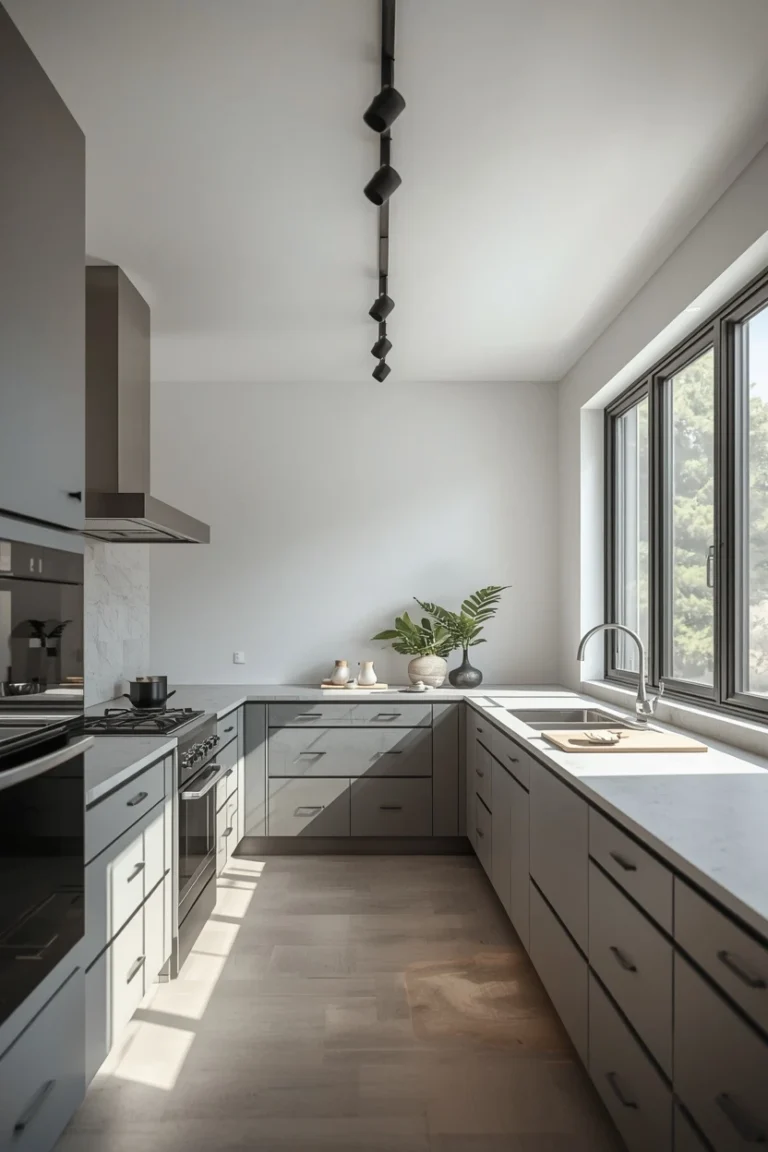
14 Kitchen Track Lighting Ideas for a Modern Upgrade
The biggest mistake people make with kitchen track lighting is treating it as a cheap workaround for missing recessed cans. That outdated…
Read more →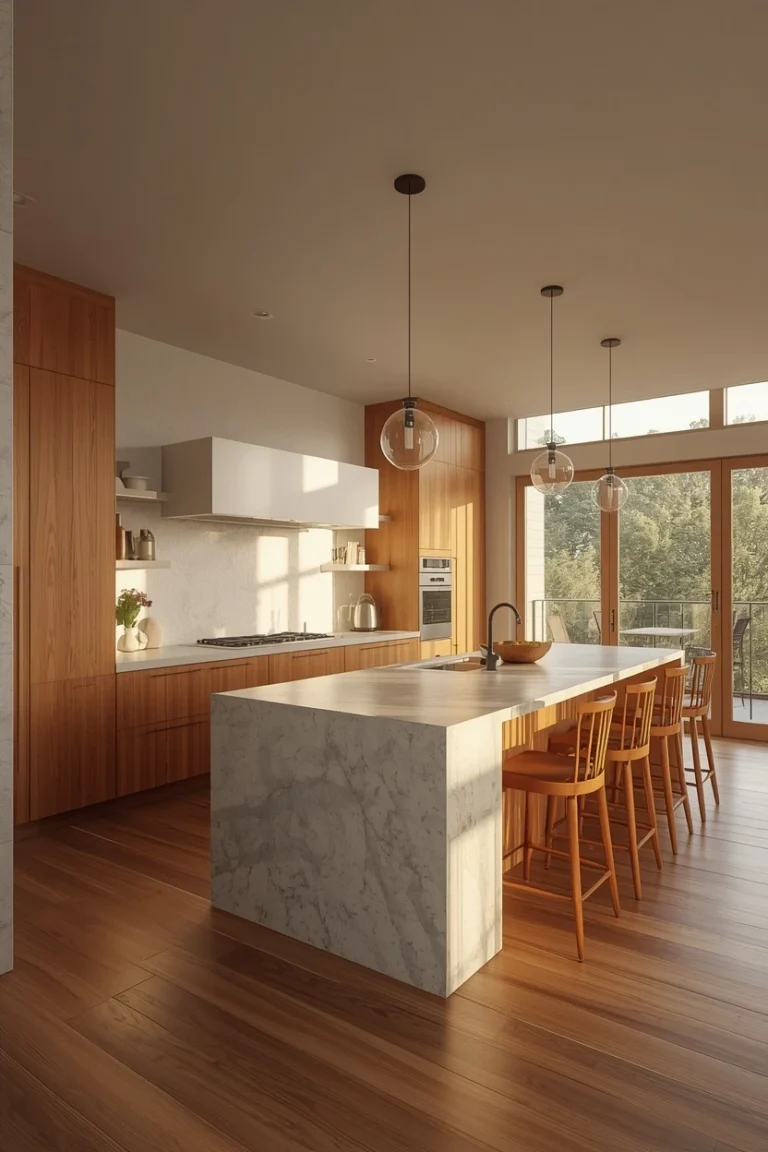
15 Kitchen Layout Ideas That Improve How You Cook
Most kitchen layout ideas start with a shape — L, U, galley — and then try to squeeze your life into that…
Read more →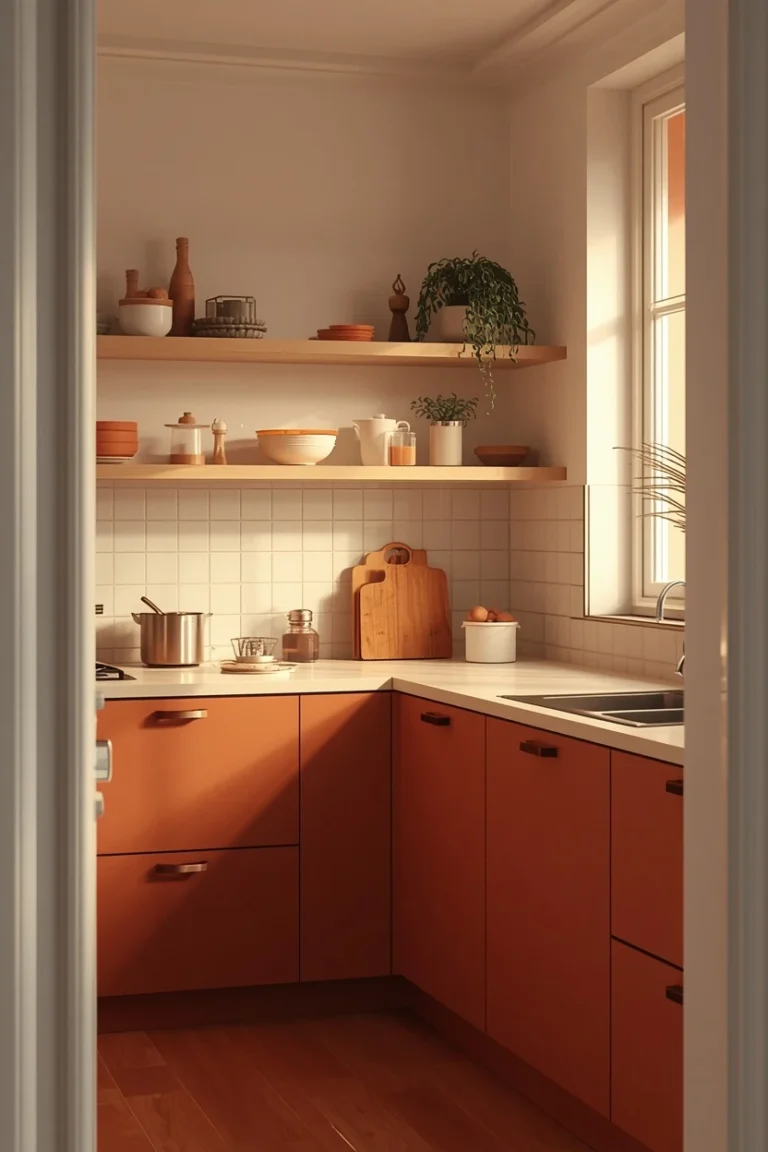
12 Kitchen Configuration Ideas for Smarter Everyday Use
The reason a kitchen configuration matters more than its shape is that two kitchens with the exact same L-shape floor plan can…
Read more →